
The Custer County Most Wanted Program
Custer County has no most-wanted program on its official pages. Neither the county, the sheriff, nor the Silver Cliff and Westcliffe sites carry a public roster, Crime Stoppers list, reward schedule, warrant roundup, amnesty week, or warrant-tip program. That describes what these offices publish, not what they hold. Law enforcement keeps internal warrant data, and an official notice could appear at any time. The official Custer County Sheriff site is the place to watch for one. Its menus cover services, resources, records and forms, documents, and a blotter. None of those areas offers a most-wanted search today. Names, photos, and alleged offenses from some other site should stay there; a local roster should carry only what the sheriff itself posts.
No Custer County Wanted Roster
The short answer is precise: Custer County publishes no public most wanted roster. That wording matters. Claiming no roster exists anywhere would reach past the evidence, since agencies add and remove web material and a caller may be pointed to a channel the site never shows. The sheriff's public pages carry no name field, filter, warrant-list button, roster rows, pagination, or update date. A missing page is not a failed search for a specific person. It only describes the public interface. If you are asking about your own warrant, call the issuing court or the sheriff and ask what status they can disclose. Skip commercial lists and stale social-media claims; neither carries live warrant status. Note: absence from a web page never proves that a person has no warrant.
How the Lists Work
Where an agency does maintain a most-wanted list, it is a chosen notice, not the full stack of unserved warrants. The publishing agency picks what appears and controls corrections, updates, and removals. A sound list names its owner, carries an update date, explains how to send a correction, and warns that status can change. Custer County's pages disclose no selection rules, update timing, or removal policy, because the sheriff posts no public list here. Suppose a Custer County most wanted list appears later. Follow the official link, read its date and disclaimer, and rely on that source alone rather than any copy of it. Live warrant status still rests with the issuing court and law-enforcement systems, never with a published page. Note: a public list is a dated agency publication, while warrant status remains with the issuing court.
Custer County Most Wanted Tip Limits
The sheriff's home page shows a general “Got a Tip?” contact at (719) 783-2270. That one line does not create a Custer County most wanted program. It also promises no anonymity, cash reward, tracking code, or Crime Stoppers protection. Expect those terms only if an official Custer County source states them. For a non-urgent tip, call the sheriff's main line and ask whether dispatch or another unit should take it. The county sheriff page also lists non-emergency dispatch at (719) 276-5555 ext. 8. Essential law-enforcement services run around the clock, while the administrative office keeps weekday hours. For an immediate threat or emergency, use 911.
- General tip
- Information offered to law enforcement through its ordinary contact route.
- Anonymous tip
- A submission made under an official process that states how identity is protected.
- Reward program
- A published official program with stated eligibility and payment terms.
How to Report a Tip Safely
Send facts through an official Custer County channel. Never confront, follow, restrain, or warn the person. Keep allegations off social media. A mistaken identity or stale claim can cause real harm, and only law enforcement can weigh the information.
- Call 911 when there is an immediate threat, active emergency, or urgent need for police response.
- For a non-emergency, call the sheriff at (719) 783-2270 or non-emergency dispatch at (719) 276-5555 ext. 8.
- State what you directly observed, where it occurred, and when. Separate facts from rumor.
- Ask which unit should receive supporting information and whether a safe follow-up method exists.
- Step back and let law enforcement decide what action is lawful and needed.
Key point: Custer sources do not promise anonymity or rewards, so ask about privacy before sharing identifying information through a non-emergency channel.
Custer County Most Wanted Verification
Before trusting any page as the Custer County most wanted list, verify it. Check the domain and the agency that owns it. Then look for a publication or update date, the notice's purpose, a correction or removal contact, and a status disclaimer. A genuine agency page directs tips to an official phone number or form. The sheriff resources page gathers emergency and public-safety contacts, and the records and forms page opens the route to sheriff-held records. Neither page is a roster just because the sheriff runs it. A records request can still be limited by Colorado criminal-justice record rules.
- Confirm the government domain and named owner.
- Look for a current update date.
- Read the correction and removal process.
- Use only the listed tip channel.
- Never copy names or photos into another list.
Most Wanted vs an Active Warrant
The two labels answer different questions. A most wanted list is a short roster an agency picks for publicity. An active warrant simply has not been executed or recalled yet. Custer County publishes no name-searchable list of those live warrants, so only the issuing court can confirm status.
| Feature | Most Wanted List | Active Warrant |
|---|---|---|
| Scope | A selected public subset, if one is published | Any warrant still open in the official system |
| Custer public source | None located in inspected pages | No public search interface located |
| Update risk | A posted notice may lag | Status may change after service or recall |
| Confirmation | The publishing agency | The issuing court and serving agency |
A blotter is different again. It logs sheriff activity in Custer County. Treat it as a warrant list only if the sheriff says so. A missing blotter entry proves nothing either way.
No Custer County Warrant Roundup
Custer County runs no warrant roundup or amnesty event. The county, its sheriff, and its towns publish none. An amnesty program needs a named sponsor, set dates, and eligibility rules spelled out in an official announcement. A roundup needs the same thing: a public notice and a contact route. Old amnesty posts from other counties never carry over to Custer County. A payment offer is not amnesty either, unless the issuing court says so in writing. If you are trying to resolve your own warrant, call the court or a lawyer directly. Ask about the appearance, bond, payment, recall, or filing steps that actually apply. The Custer County active warrant reference lists those official contacts without pretending to be a roster. Any future event belongs at its official announcement, described with its published dates. Once an event ends, its page should say so plainly. A stale urgent call to action only misleads people.
If You Believe You Are on a List
No Custer County office runs a warrant roundup or amnesty event. The county, the sheriff, and the towns publish none. A real amnesty day would carry a named sponsor, set dates, eligibility rules, and clear steps. A real roundup would come with an official announcement and a contact route. Old event posts from other counties do not travel here. Paying money is not amnesty either, unless the issuing court itself says so. If you are working on your own warrant, call the court or a lawyer and ask about appearance, bond, payment, recall, or filing. The Custer County active warrant reference points to those local offices without promising a roster. If an amnesty event ever appears, follow its official announcement and dates. After it ends, that announcement should read as expired rather than sitting online with an urgent call.
Important: Get legal advice before acting on a claimed listing, and do not rely on social media to confirm or resolve a warrant.
Custer County and Federal Wanted Lists
A federal fugitive notice is not a Custer County most wanted list. Federal cases run through the U.S. District Court for the District of Colorado, PACER for docket material, and the U.S. Marshals Service for fugitive work. State court and county sheriff pages do not establish federal warrant status. Public federal dockets have limits too. Sealed documents and nonpublic warrant information may not appear. Use a federal page only to find your way through the federal system, not to infer a local warrant or build a list of people. The official District of Colorado courthouse source shows that separate federal system and its courthouse locations.
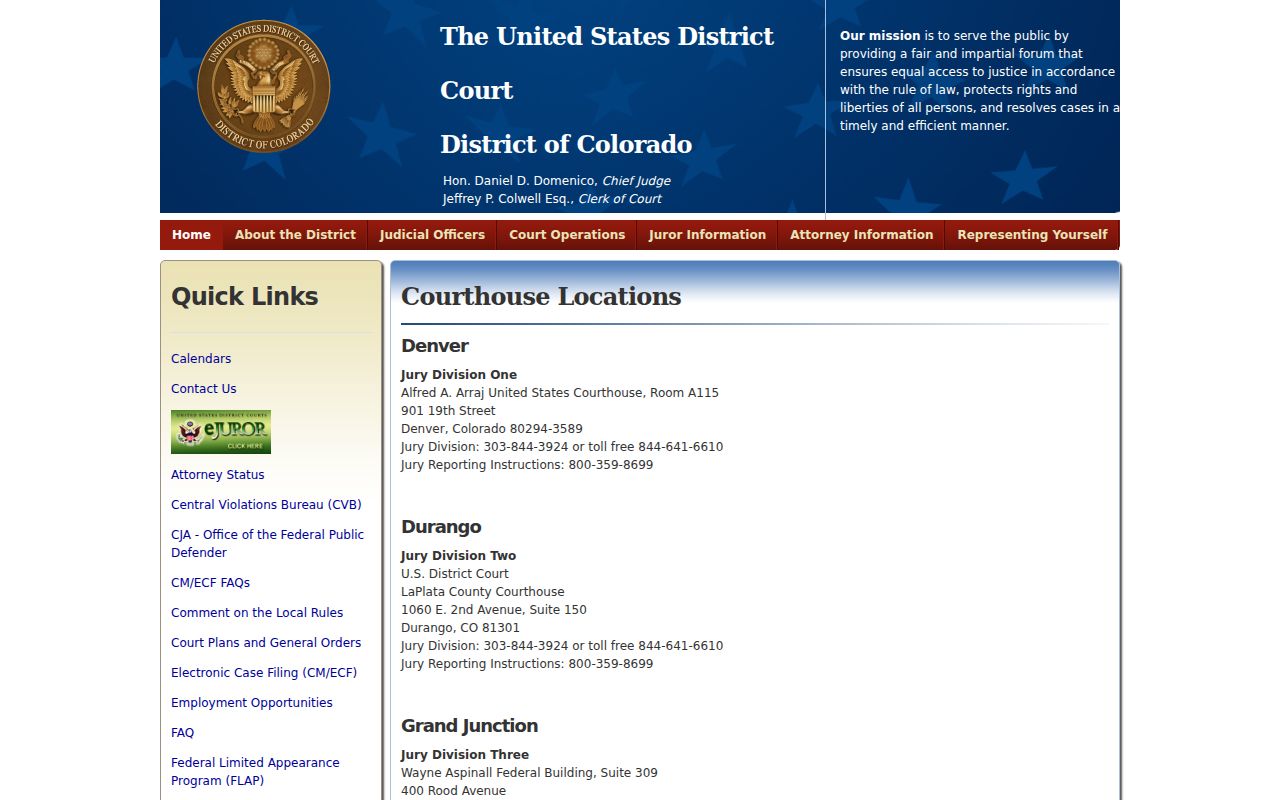
That official page offers court location context, not a Custer County roster or a live federal warrant search. Use it for addresses only.
Note: Rely on official notices directly and never on any republished roster of names, faces, mugshots, or addresses.